HIU Service & Repair London

24/7 HIU emergency repairs and servicing, with a fast response across all London postcodes.

Book an Appointment
Illustrated PH247 plumber mascot

A heat interface unit is what gives your flat heating and hot water when the building runs on a communal or district heat network. There is no boiler and no flame. The HIU takes heat from the building’s central plant and passes it to your radiators and taps through plate heat exchangers. When it stops working, you lose both at once.

PH247 services, repairs and replaces HIUs across London. We work in individual flats for residents and leaseholders, and across whole blocks for managing agents and freeholders. Annual servicing is £150 inc VAT. Emergency repair callouts start from £150 inc VAT.

Manufacturers require an annual service by a qualified engineer to keep the warranty valid. Most units in London also need the strainer cleaning more often than that, because the water here is hard enough to choke one inside six months.

What an HIU service includes

Every service follows the same sequence.

Isolation. We isolate the 230V supply, close the primary district heating flow and return valves, and isolate the secondary heating and cold water circuits. Valves get tagged so nobody reopens them mid-job.

Strainers. The primary strainer cap comes off, the mesh comes out, and it gets cleaned with high-velocity water to clear magnetite sludge, rust and installation debris. We do the same on the 800 micron secondary heating strainer. A blocked strainer is the single most common reason an HIU stops producing hot water.

Expansion vessel and safety valve. We check the charge pressure on the heating expansion vessel and recharge it to 0.75 bar. We discharge the 3 bar safety relief valve by hand and confirm it re-seats and seals, then check the discharge pipework.

Plate heat exchangers. Both the hot water and heating exchangers get inspected for weeping and scale. Where thermal performance has dropped from limescale, we descale in place using compatible organic acids. If we take a plate pack apart, the tie bolts are torqued in a star pattern and the plate gap measured at all four corners.

Control valve and actuator. The pressure independent control valve gets a full stroke test from closed to open to confirm the actuator moves cleanly.

Pump. We check speed settings, listen for bearing noise, and confirm the anti-seize program is active. That routine runs the pump for five seconds every 24 hours so it does not lock up over summer.

Refill and vent. The heating system goes back to 2 bar, air is bled from radiators and the automatic air vent, and we confirm hot water and heating both run.

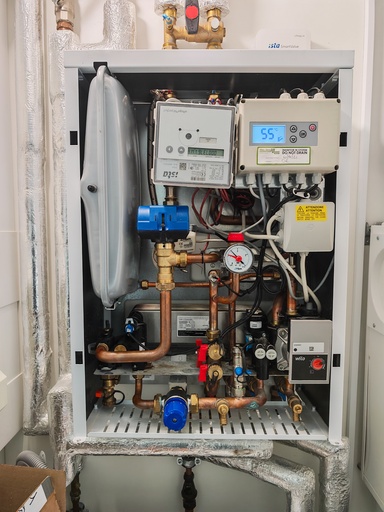
HIU Unit with the cover off

Common HIU faults and what causes them

No hot water at all. Usually a blocked primary strainer starving the plate heat exchanger. Sometimes a failed hot water actuator, sometimes the network itself is down. If your neighbours have the same problem, the fault is on the building side.

Hot water runs warm, or starts hot then goes cold. Limescale inside the plate heat exchanger channels. London water sits well above the 200 ppm hardness threshold where calcite starts to precipitate. The controller compensates by opening the primary valve wider, which pushes your return temperature up and costs the whole network efficiency. We wrote up a job where exactly this was happening: our HIU lukewarm hot water case study.

Erratic or hunting hot water temperature. Scaling on the control valve stem, or a burnt out actuator motor. Descale and stroke test, replace the cartridge if worn.

Heating cuts out and shows a fault light. The secondary circuit has dropped below its low pressure threshold, 0.4 bar or 0.7 bar depending on model. The unit cuts power to the pump to stop it burning out. The unit is doing its job. You have a leak somewhere on your heating circuit.

Pressure keeps dropping. Either a real leak, or a failed internal pressure sensor. Particulate on the sensor diaphragm and kinked capillary tubes both make a healthy system read as empty.

Damp cupboard or visible water. Gasket weeping at the plate pack margins, a failed connection, or corrosion. Pressure spikes and water hammer degrade gaskets over time.

Noise. Get a new or worsening noise checked before it turns into a failure.

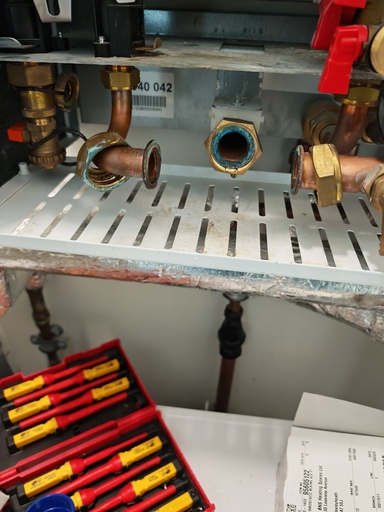
HIU no blending valve
4.96 / 5
1,200+ Verified Customer Reviews
Vetted & Approved by TrustATrader 0 missed appointments in the past 6 months
Read all 1,200+ reviews
PH247 is a vetted TrustATrader member (TT19385)

What goes in your service report

Every service visit produces a written report. It records the unit and the work carried out, so you have evidence of what was done and what condition the unit was in.

  • HIU make, model and serial number
  • Confirmation that the primary and secondary strainers were cleaned
  • Expansion vessel charge pressure and static heating system pressure
  • Hot water and heating performance checks on completion
  • Condition of the plate heat exchangers, control valve and pump
  • Any parts replaced, and any faults found but not fixed on the visit
  • Heat meter reading where a meter is fitted

For a single flat that is a record for your own files. For a block it is the evidence trail your heat network needs.

HIU servicing for managing agents and blocks

Servicing a block one flat at a time is how records go missing. We quote whole blocks as a single programme: a scheduled run through every unit, one engineer team, one consistent report format, and a single point of contact for access problems and no-shows.

Multi-unit work is quoted per block rather than per flat, because access, unit type and the state of the network vary too much for a list price to mean anything. Send us the unit count, the HIU make and model, and the last service dates you have.

We also work alongside your existing arrangements. If you have a network operator handling the energy centre, we cover the HIUs inside the flats.

More on how we work with managing agents and freeholders: HIU and plumbing services for property managers.

The January 2027 Ofgem deadline

If you run or own a block on a communal heat network, this applies to you.

Ofgem became the statutory regulator for heat networks on 27 January 2026 under the Heat Networks (Market Framework) (Great Britain) Regulations 2025. Every operator and supplier must be registered with Ofgem by 26 January 2027. The digital registration service opened in April 2026.

The scope is wider than most freeholders expect. A building with a communal heating system serving separate dwellings is very likely in scope, even if nobody there has ever thought of the building as an energy supplier. There are roughly 14,000 heat networks in Great Britain.

Separately, the Heat Network Technical Assurance Scheme sets technical performance standards, with enforcement expected from late 2027. HNTAS makes volume weighted average return temperature a reportable figure. Badly commissioned or heavily scaled HIUs pull that number up, and operators with persistently high return temperatures will have to show a remediation plan.

Many older networks have HIUs that were never commissioned to CIBSE CP1 standards, or whose commissioning records no longer exist. Auditing those now is easier than doing it under a deadline.

PH247 services and repairs HIUs and gives you the written records behind each visit. Registering your network with Ofgem is a separate job that we do not handle.

When to replace rather than repair

Repair is usually cheaper. These are the cases where it is not.

Pinhole leaks and corrosion. Weeping joints across the unit, corrosion at copper to brass interfaces, or pinholes in the chassis pipework. Once the structure is going, piece by piece repair costs more than a new unit.

Plates too scaled to recover. When clean-in-place descaling no longer restores heat transfer, or the plates have corroded far enough to let the two circuits mix, the exchangers need replacing. On an older unit, replacing the whole HIU usually costs less.

Older thermostatic and hybrid units. Units with purely thermostatic control are being phased out. They struggle to pass the standby and space heating thresholds in the BESA Version 3.1 test standard, and they cannot hold return temperatures down the way a fully electronic unit can.

Units tested under the retired standard. BESA retired the 2018 Version 2 test standard. Units tested under it are no longer registered, which matters on any network that has to demonstrate technical assurance.

PH247 carries out full HIU replacements as well as service and repair.

HIU brands we work on

Our engineers work on all major HIU brands, including Evinox, Danfoss, Altecnic, Heatrae Sadia and Intatec.

Other ranges common on London heat networks include SAV Termix VVX, Intatec Hiper II and Hiper Xi, Altecnic SATK22 and SATK32, Ideal Heating POD and Logic HIU, Vital Energi vTherm, Baxi, Bosch Flow, Cetetherm, Modutherm and Switch2.

If your unit is not listed, send us a photo of the data plate and we will confirm before booking.

Frequently Asked Questions

How much does an HIU service cost in London?

PH247 charges £150 inc vat for an annual HIU service in London, including strainer clean, pressure check, and a written report. Emergency repair callouts start from £150 inc vat.

How often should a heat interface unit be serviced?

HIUs should be serviced annually. In London’s hard water areas, strainer cleaning may be needed every 6 months to prevent flow restriction and loss of hot water.

Can PH247 repair any brand of HIU?

Yes. Our engineers work on all major HIU brands including Evinox, Danfoss, Altecnic, Heatrae Sadia, Intatec, and all other models.

What causes loss of hot water with an HIU?

The most common cause is a blocked strainer restricting flow to the plate heat exchanger. This is resolved during a standard service visit. Other causes include a faulty DHW actuator or scale buildup on the heat exchanger.

Do you offer emergency HIU repair in London?

Yes. PH247 provides 24/7 emergency HIU repair across London. Call us for same-day attendance on heating and hot water failures.

Do you service HIUs across a whole block?

Yes. Block and portfolio work is quoted per site rather than per flat. Send the unit count, the HIU make and model, and any existing service records, and we will quote a scheduled programme.

What should I have ready before an HIU engineer visits?

A photo of the data plate showing make and model, any fault code or flashing light on the display, whether the problem affects hot water, heating or both, and whether your neighbours are affected too. If they are, it is likely a building side fault.

Can PH247 replace an HIU as well as repair one?

Yes. We carry out full HIU replacements. On older units with heavy scaling or corrosion, replacement is often cheaper than repeated repairs.


1
Scan the code